A house on the Trieste Karst: prices, Natura 2000, sewage, rules
A Karst villa costs €1,700–2,250/m² (OMI 2026), below the Costiera. Natura 2000, protected woods, collective land and sewage permits come with it.
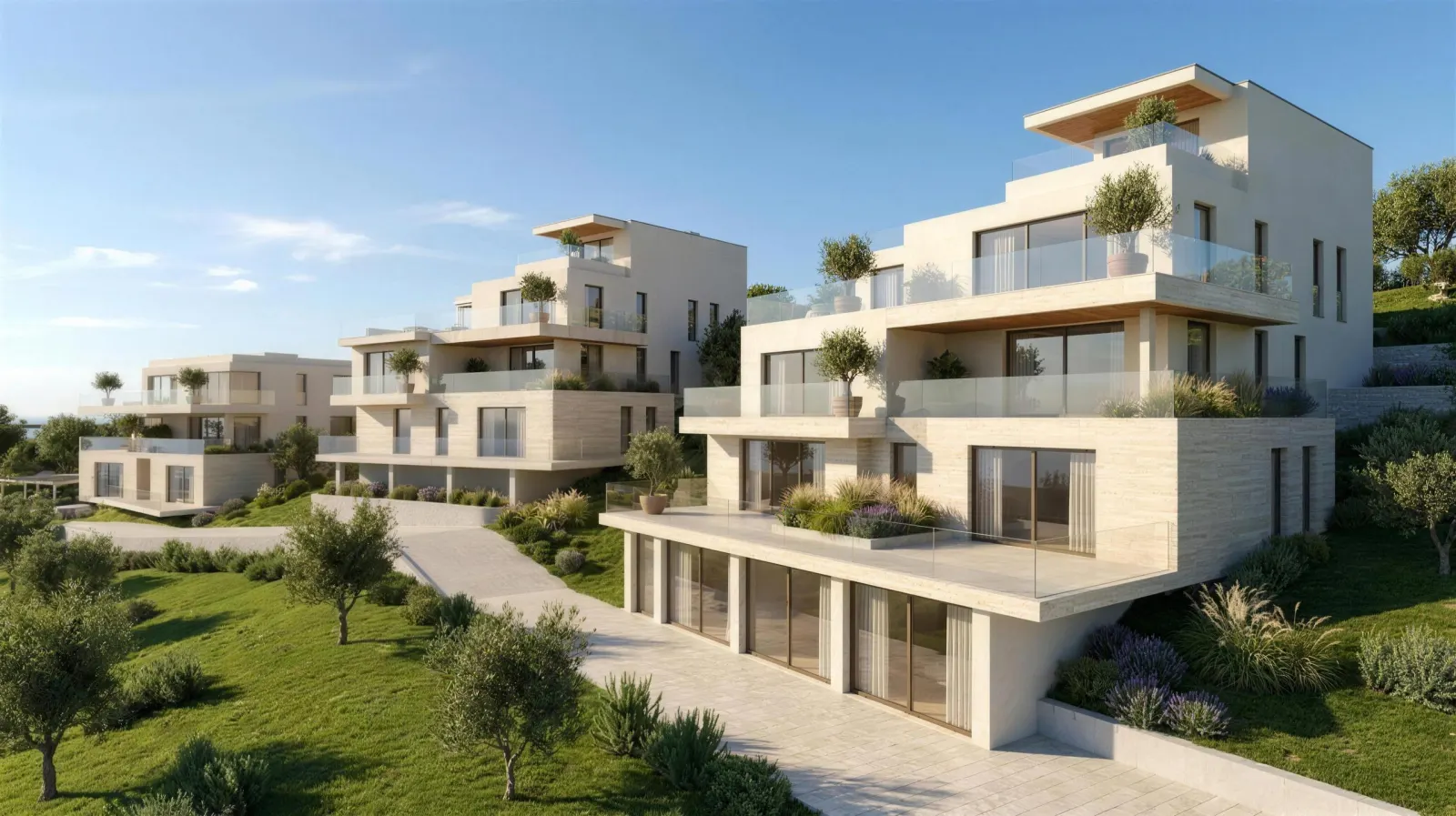
 AI · rendering
A villa in the Karst villages above Trieste costs €1,700–2,250 per square metre in OMI's figures for the first half of 2026, against €2,100–3,100 on the Costiera below. OMI is the property market observatory run by Italy's revenue agency.
The discount is real. So are the rules that come with the plateau: European nature sites, woodland and collective land under landscape protection, houses that may not be on the sewer, and a ground full of caves. None of them shows in a listing photograph.
In short
- Prices: villas €1,700–2,250/m² in Trieste's Karst villages, €1,800–2,450 in Opicina, €1,550–2,200 in rural Sgonico (OMI, first half 2026).
- Natura 2000: two European sites cover the Trieste Karst. Works inside one, or bordering it, go through an incidence screening before the permit.
- Landscape: woods, nature reserves and land under civic uses are protected by the landscape code itself.
- Collective land: land of the old village communities cannot be sold. Check the title before you fall for the garden.
- Sewage: every discharge outside the public sewer needs an authorisation. The Region pays up to €3,500 towards connecting a home to the sewer.
What does a house on the Karst cost?
OMI gives a minimum and a maximum per zone and per square metre of gross floor area, for homes in normal condition. On the plateau the values sit below the coast and close to each other.
| Zone (OMI, first half 2026) | Villas, €/m² | Ordinary flats, €/m² |
|---|---|---|
| Trieste, Karst villages (R1) | 1,700–2,250 | 1,750–2,250 |
| Trieste, Opicina (D2) | 1,800–2,450 | 1,800–2,500 |
| Trieste, Gretta – Barcola – Costiera (D3) | 2,100–3,100 | 2,150–3,100 |
| Sgonico, rural zone (R1) | 1,550–2,200 | 1,550–2,000 |
| Monrupino, whole municipality (B1) | 1,500–2,150 | — |
In Monrupino OMI also lists villas in excellent condition, at €2,150–2,800. OMI warns that its ranges do not replace a valuation of a single property.
Worked example: a villa of 200 m² gross. In Trieste's Karst villages it comes to €340,000–450,000 at OMI values; on the Costiera, €420,000–620,000. The gap is €80,000 at the floor and €170,000 at the ceiling. These are hypotheses on OMI values, our arithmetic, not prices.
For the feel of each area, read Trieste, area by area.
Is the house inside a Natura 2000 site?
Probably close to one. The Region lists two sites on the Karst: the special area of conservation IT3340006 «Carso Triestino e Goriziano» and the special protection area for birds IT3341002 «Aree carsiche della Venezia Giulia». The Region updated the measures for the second in December 2025 (resolution 1760 of 5 December 2025).
What it means for you is a procedure, the incidence assessment (valutazione di incidenza, VIncA). It comes from article 6 of the Habitats Directive and, in Italy, from article 5 of Presidential Decree 357 of 1997. In Friuli Venezia Giulia it applies to projects and works whose area falls even partly within a site, or borders one.
It has three levels: a screening, an appropriate assessment, and a third level for the rare cases that go further. Some works are exempt: those the conservation measures already allow and regulate, and those the Region has pre-assessed as harmless (resolution 119 of 23 January 2023).
For a buyer: if you plan a pool, an extension, a new outbuilding or a fence across a meadow, ask your architect at the outset whether the plot is in or next to a site, and which level applies. It changes the timetable, not only the paperwork.
Which landscape rules reach the plateau?
Several, and they come from the law itself. The landscape code (Legislative Decree 42 of 2004, article 142) protects by law, among others:
- land covered by forests and woods, even if burnt or damaged by fire;
- national and regional parks and reserves;
- land under civic uses (usi civici).
For woods and civic-use land, though not for reserves, the rule does not apply to areas that on 6 September 1985 were already zones A or B of the town plan. On protected land, outside changes need landscape authorisation before work starts. The Region lists thirteen regional nature reserves, among them Val Rosandra, Monte Lanaro and Monte Orsario.
How the sea-view rules work, from verandas to air conditioning, is explained in buying a sea-view home in Trieste.
Can the land around the house be collective?
Yes, and it is the question foreign buyers least expect. Italian law recognises collective domains, the land of the old village communities (Law 168 of 2017). That land cannot be sold, divided or acquired by long possession, and it stays bound to farming, forestry and grazing (article 3).
The law also covers private land on which residents still hold civic uses not yet settled. Even after civic uses are settled, the landscape protection stays.
For a buyer: a meadow used as a garden for decades is not yours just because it is fenced. Ask the notary to check, on the Libro fondiario and with the municipality, that every parcel in the sale is free of collective rights. See the Trieste land register.
What if the woods around it have burnt?
Then a 15-year rule applies. Woods and pastures burnt by fire cannot change their use for at least 15 years, and every deed of sale signed in that period must mention the constraint, or it is void (Law 353 of 2000, article 10). Building on burnt woodland is banned for ten years, unless the town plan allowed it before the fire.
Each municipality keeps a register of burnt land, updated every year. Ask for the extract that covers the parcels.
Is there a cave under the garden?
Possibly: the Karst is limestone. The Region keeps the regional speleological register (Catasto speleologico regionale), set up by regional law 15 of 2016, which records caves, karst areas and karst aquifers. A cave entrance or a sinkhole on the plot is a matter for your surveyor before you sign.
Water and sewage: what should I check?
Whether the house is on the public sewer. Under the environmental code, every discharge needs prior authorisation (Legislative Decree 152 of 2006, article 124). Domestic waste water into a public sewer is always allowed, under the operator's rules. For isolated buildings, the regions set the individual systems allowed (article 100).
If the house has a septic tank, ask for its discharge authorisation. If it could connect, the Region pays private owners up to €3,500 towards the connection, through the municipality (regional law 13 of 2023, article 4). In 2026 applications ran from 18 May to 19 June, online only, with an Italian digital identity (SPID or CIE) or a national or regional services card. Works must have started after 31 October 2020 and be finished before you apply.
The Region also funds rainwater collection and reuse systems for private homes.
What does it cost each year?
In the municipality of Trieste a second home pays ILIA, the regional property tax, at 1.06% a year of its cadastral value; the rate drops to 0.70% for one second home, the first you list with the Region. Sgonico, Monrupino and the other municipalities set their own rates. Running costs year by year are in owning in Trieste.
What to do now
- Locate the house on the Natura 2000 map and on the town plan's constraints map before the offer.
- Ask the seller for building permits, landscape authorisations and the sewage authorisation.
- Have the notary check every parcel on the Libro fondiario, including rights of way to the road.
- Ask the municipality for the burnt-land register extract for the parcels.
- Have a surveyor look for caves and sinkholes, and price any project against the incidence procedure.
Frequently asked questions
Can I build a pool on the Karst near Trieste?
Often, but not quickly. You need a building permit, usually a landscape authorisation, and, in or beside a Natura 2000 site, an incidence screening first.
Is the Trieste Karst a protected area?
Large parts are. Two Natura 2000 sites cover it, woods are protected by the landscape code, and there are regional reserves such as Val Rosandra and Monte Lanaro.
Are Karst houses connected to the sewer?
Not all. Every discharge outside the sewer needs an authorisation; ask for it, or for proof of connection, before you sign.
How much does a villa on the Karst cost?
In Trieste's Karst villages OMI gives villas €1,700–2,250/m² for the first half of 2026, against €2,100–3,100 on the Costiera.
Where this guide stops
It gives no value for a specific house, does not map which plots fall in which site, and does not cover farmland pre-emption or agricultural buildings. For permits, an architect or surveyor; for title and collective rights, the notary.
If you own a house on the Karst, we gather the permits, the sewage papers and the title checks before a foreign buyer's surveyor asks for them, and we price it against the plateau, not the coast. Request a confidential valuation: we sell in English and German.
These are the rules, not legal advice: on your case the last word belongs to the notary and your architect.
Sources
- Agenzia delle Entrate, scheda OMI Trieste zona R1 (Regione agraria 19 – I borghi dell'Altipiano), 1° semestre 2026 — Fascia extraurbana; abitazioni civili NORMALE 1750–2250 €/mq; ville e villini NORMALE 1700–2250; superficie L (lorda); letta il 2026-11-10
- Agenzia delle Entrate, scheda OMI Trieste zona D2 (Opicina), 1° semestre 2026 — Abitazioni civili NORMALE 1800–2500 €/mq; ville e villini NORMALE 1800–2450; L; letta il 2026-11-10
- Agenzia delle Entrate, scheda OMI Trieste zona D3 (Parte Gretta – Barcola – Costiera), 1° semestre 2026 — Abitazioni civili NORMALE 2150–3100 €/mq; ville e villini NORMALE 2100–3100; L; letta il 2026-11-10
- Agenzia delle Entrate, scheda OMI Sgonico zona R1 (Regione agraria 19), 1° semestre 2026 — Abitazioni civili NORMALE 1550–2000 €/mq; ville e villini NORMALE 1550–2200; L; letta il 2026-11-10
- Agenzia delle Entrate, scheda OMI Monrupino zona B1 (Intero territorio del Comune), 1° semestre 2026 — Ville e villini NORMALE 1500–2150 €/mq, Ottimo 2150–2800; abitazioni di tipo economico 1150–1600 (nessuna voce «abitazioni civili»); L; letta il 2026-11-10
- Agenzia delle Entrate, GEOPOI, elenco delle zone OMI del Comune di Trieste — R1 «REGIONE AGRARIA 19 - I BORGHI DELL`ALTIPIANO», D2 «OPICINA», D3 «PARTE GRETTA - BARCOLA - COSTIERA». Calcolo nostro: villa di 200 mq lordi × 1700 = 340.000 €, × 2250 = 450.000 €; × 2100 = 420.000 €, × 3100 = 620.000 €; differenze 80.000 € e 170.000 €; letta il 2026-11-10
- Agenzia delle Entrate, Manuale dell'Osservatorio del mercato immobiliare (2025) — Intervalli minimo-massimo per zona, semestrali; le quotazioni OMI «non possano intendersi sostitutive della stima puntuale del valore del singolo immobile»; letta il 2026-11-10
- Regione FVG, La Rete Natura 2000 (tabella dei siti e misure di conservazione) — «IT3340006 ZSC Carso Triestino e Goriziano»; «IT3341002 ZPS Aree Carsiche della Venezia Giulia»; «Per il sito IT3341002 – ZPS Aree Carsiche della Venezia Giulia sono state aggiornate le misure ed identificati gli obiettivi di conservazione con DGR 1760 del 05/12/2025»; la VIncA «si articola in tre livelli: Screening, Valutazione appropriata; Valutazione di III livello»; pagina aggiornata il 23/06/2026; letta il 2026-11-10
- Regione FVG, Valutazione di incidenza ecologica (VINCA) — Procedura introdotta dall'art. 6, c. 3, della Direttiva 92/43/CEE «Habitat»; recepita con l'art. 5 del DPR 357/1997; DGR 1183 del 5/8/2022; soggetti i P/P/P/I/A la cui area «comprende, anche parzialmente, uno o più Siti Natura 2000 o risulta con essi confinante»; non soggetti i P/I/A «specificatamente consentiti e regolamentati dalle Misure di conservazione» e quelli già oggetto di pre-valutazione; «Con DGR 119 del 23 gennaio 2023 la Regione ha approvato le Pre-valutazione di incidenza»; letta il 2026-11-10
- D.lgs. 22 gennaio 2004, n. 42, art. 142 — C. 1: f) «i parchi e le riserve nazionali o regionali»; g) «i territori coperti da foreste e da boschi, ancorché percorsi o danneggiati dal fuoco»; h) «le aree assegnate alle università agrarie e le zone gravate da usi civici»; c. 2: non si applica alle aree che al 6 settembre 1985 erano zone territoriali omogenee A e B; letto il 2026-11-10
- D.lgs. 42/2004, art. 146 — I proprietari di immobili e aree tutelati non possono introdurvi modificazioni che rechino pregiudizio ai valori paesaggistici e devono astenersi dall'avviare i lavori fino all'autorizzazione; letto il 2026-11-10
- Regione FVG, Le Riserve naturali regionali — Elenco di tredici riserve: Forra del Cellina, Lago di Cornino, Valle Canal Novo, Foci dello Stella, Valle Cavanata, Foce dell'Isonzo, Laghi di Doberdò e Pietrarossa, Falesie di Duino, Monte Lanaro, Monte Orsario, Val Rosandra, Val Alba, Valli Grotari e Vulcan (conteggio nostro); letta il 2026-11-10
- Legge 20 novembre 2017, n. 168, art. 1 — «la Repubblica riconosce i domini collettivi, comunque denominati, come ordinamento giuridico primario delle comunità originarie»; c. 2: gli enti esponenziali hanno personalità giuridica di diritto privato; letto il 2026-11-10
- Legge 20 novembre 2017, n. 168, art. 3 — C. 1 lett. d: «le terre di proprietà di soggetti pubblici o privati, sulle quali i residenti del comune o della frazione esercitano usi civici non ancora liquidati»; c. 3: «Il regime giuridico dei beni di cui al comma 1 resta quello dell'inalienabilità, dell'indivisibilità, dell'inusucapibilità e della perpetua destinazione agro-silvo-pastorale»; c. 6: il vincolo paesaggistico sulle zone gravate da usi civici «è mantenuto sulle terre anche in caso di liquidazione degli usi civici»; letto il 2026-11-10
- Regio decreto 28 marzo 1929, n. 499, art. 2 — Nei territori del Libro fondiario il diritto di proprietà e gli altri diritti reali sui beni immobili non si acquistano per atto tra vivi se non con l'iscrizione del diritto nel libro fondiario; letto il 2026-11-10
- Legge 21 novembre 2000, n. 353, art. 10 — C. 1: zone boscate e pascoli percorsi dal fuoco «non possono avere una destinazione diversa da quella preesistente all'incendio per almeno quindici anni»; negli atti di compravendita stipulati entro quindici anni «deve essere espressamente richiamato il vincolo ... pena la nullità dell'atto»; vietata per dieci anni la realizzazione di edifici, salvo previsione degli strumenti urbanistici vigenti prima dell'incendio; c. 2: i comuni censiscono i soprassuoli percorsi dal fuoco «tramite apposito catasto», «aggiornato annualmente»; letto il 2026-11-10
- Regione FVG, Catasto Speleologico Regionale (CSR) — Legge regionale 14 ottobre 2016, n. 15, per la «conoscenza, tutela e promozione del patrimonio speleologico (grotte, cavità artificiali e forre)»; il CSR, regolamento DPReg. 04/04/2018 n. 0064, centro di raccolta dati «del patrimonio speleologico, delle aree carsiche e degli acquiferi carsici»; letta il 2026-11-10
- D.lgs. 3 aprile 2006, n. 152, art. 124 — C. 1: «Tutti gli scarichi devono essere preventivamente autorizzati»; c. 3: il regime autorizzatorio degli scarichi di acque reflue domestiche è definito dalle regioni; c. 4: «gli scarichi di acque reflue domestiche in reti fognarie sono sempre ammessi nell'osservanza dei regolamenti fissati dal gestore del servizio idrico integrato»; letto il 2026-11-10
- D.lgs. 152/2006, art. 100 — C. 3: «Per insediamenti, installazioni o edifici isolati che producono acque reflue domestiche, le regioni individuano sistemi individuali o altri sistemi pubblici o privati adeguati»; letto il 2026-11-10
- Regione FVG, Contributi a privati per l'allacciamento delle abitazioni alla rete fognaria — L.R. 10 agosto 2023, n. 13, art. 4, c. 1: contributo «fino all'importo massimo di 3.500 Euro», «per il tramite dei Comuni», a persone fisiche proprietarie di unità a destinazione esclusivamente abitativa; 2026: domande dalle 9.00 del 18 maggio 2026 alle 16.00 del 19 giugno 2026, «esclusivamente in modalità telematica», con SPID, CIE, CNS o CRS; spese per lavori «conclusi precedentemente alla data di presentazione della domanda ed iniziati successivamente alla data del 31 ottobre 2020»; pagina aggiornata il 31/08/2026; letta il 2026-11-10
- Regione FVG, Contributi a persone fisiche per sistemi di raccolta e riutilizzo delle acque meteoriche — Titolo della linea: «Contributi destinati alle persone fisiche proprietarie di unità immobiliari destinate esclusivamente a uso abitativo privato ... a rimborso degli oneri sostenuti per la realizzazione di sistemi di raccolta e di riutilizzo delle acque meteoriche»; letta il 2026-11-10
- Comune di Trieste, Nota integrativa al bilancio di previsione 2026-2028 (allegato 10) — ILIA, tabella aliquote vigenti: abitativi diversi dall'abitazione principale 1,06%, primo fabbricato individuato con la comunicazione (art. 13 bis L.R. 17/2022) 0,70%; letta il 2026-10-31; riletta il 2026-11-10
- L.R. Friuli Venezia Giulia 14/11/2022, n. 17 (ILIA), testo vigente — Art. 9 (Aliquote): c. 2, primo fabbricato ad uso abitativo (art. 4, c. 1, lett. b bis) «0,7 per cento e i Comuni, con deliberazione del consiglio comunale, possono diminuirla»; c. 3, altri fabbricati abitativi «0,86 per cento e i Comuni ... possono aumentarla sino all'1,06 per cento o diminuirla»: ogni Comune fissa le sue aliquote; letta il 2026-11-10